If you own property along the Front Range, there’s a new rule in town, and it’s a big one. On July 1, 2025, Colorado adopted its first statewide wildfire building code, the Colorado Wildfire Resiliency Code (CWRC). It sets minimum fire safety standards for new construction and additions within designated wildland-urban interface (WUI) areas, and it’s already reshaping what materials are allowed on homes and commercial buildings near open space, foothills, and tree lines.
Local jurisdictions across Colorado, including right here in Colorado Springs, are required to adopt the CWRC as a baseline by April 1, 2026, with full compliance required by July 1, 2026. Some may choose to go even further with stricter local requirements. Either way, if your property sits in a WUI zone, this is worth understanding now rather than when you’re mid-permit for a new deck or a siding replacement.
Colorado isn’t alone in making this move, but it is one of the first states to put a statewide standard in place rather than leaving fire hardening entirely up to individual counties and cities. Given how much of the Front Range sits right up against foothills, canyons, and open grassland, that shift is a meaningful one for anyone building, remodeling, or re-siding a property in the region.
What Counts as a WUI Zone
Wildland-urban interface simply means the area where homes and businesses sit close enough to wildland vegetation, forest, or grassland that wildfire is a realistic risk to the structure. In practice, this covers a lot more of Colorado Springs and the surrounding communities than people expect, not just properties tucked into the foothills. The state has published an official CWRC map, and your local building department can confirm whether a specific address falls inside a designated zone and which fire intensity classification applies. That classification is what determines exactly which materials you’re required to use.
What the Code Actually Requires
The CWRC splits WUI zones into fire intensity classifications, and the material requirements scale with the risk:
Low Fire Intensity zones need Class 1 structural hardening. That means Class A roof coverings, noncombustible gutters, and ember or flame resistant vents.
Moderate to High Fire Intensity zones need both Class 1 and Class 2 hardening. For exterior walls specifically, that means the wall covering has to be a noncombustible material, fire-retardant-treated wood, or another ignition-resistant product. Vinyl siding is only allowed as an exception if it’s paired with a 1-hour fire-rated wall assembly.
It’s worth noting that these requirements generally apply to new construction and additions, but a significant alteration to an existing structure, such as a large-scale siding replacement, can also trigger compliance. That’s a detail that catches a lot of homeowners off guard mid-project, so it’s worth confirming with your local building department before you get too far into planning.
Locally, the Colorado Springs Fire Marshal’s office has its own WUI submittal requirements layered on top of the statewide code. A few worth flagging if you’re planning a project:
- Wood decking and stair treads are not permitted in WUI zones. Decking has to be fiber cement, concrete, or another approved ignition-resistant material.
- If you’re replacing 50% or more of a home’s siding, a WUI inspection is required, and Colorado Springs Fire Department has to sign off on the permit.
- Exterior wall posts and columns need noncombustible protection at their base.
- Patio and deck cover roofing has to be Class A material such as concrete, metal, clay, or synthetic slate.
- Homeowners submitting for decks, siding replacements, or ancillary structures typically need to sign an acknowledgement form as part of the permit process.
- Fuels management rules also come into play near the structure. Combustible storage, such as firewood, isn’t allowed within 15 feet of the home, and there are specific setback and spacing requirements for trees and brush close to the building.
None of this is meant to make a straightforward exterior project feel complicated, but it does mean the material decision and the permitting process are more connected than they used to be. Picking a compliant material from the start saves you from redoing paperwork, or worse, redoing the work itself.
Why This Matters Beyond the Paperwork
Colorado has seen its wildfire risk climb steadily over the past decade, and the Front Range in particular sits in a tricky spot where dry grassland, dense tree cover, and rapid residential growth all overlap. The CWRC exists because embers and radiant heat from a wildfire can ignite a structure long before flames ever reach the property line. Combustible siding, decking, and vents give a fire more fuel and more ways in. Hardening a structure’s exterior isn’t just a box to check for a permit, it’s a real factor in whether a home survives an ember storm during a nearby fire.
Where Hardie Fiber Cement Fits In
This is where fiber cement siding earns its reputation. Hardie siding is fully compliant with CWRC Class 2 structural hardening requirements right out of the gate. It’s verified noncombustible per ASTM E136, it carries a Class A fire rating under ASTM E84 with a flame spread index of 0, and it simply won’t contribute fuel to a fire. No extra assembly required, no workaround needed.
Compare that to the alternatives:
- Fire-retardant-treated wood is compliant, but it still contributes fuel to a fire and tends to cost more over the life of the home between materials and upkeep.
- Vinyl is only compliant with a required 1-hour fire-rated assembly tacked on, which adds cost and complexity, and it still contributes fuel to a fire.
- Natural or engineered wood does not meet the code at all in these zones.
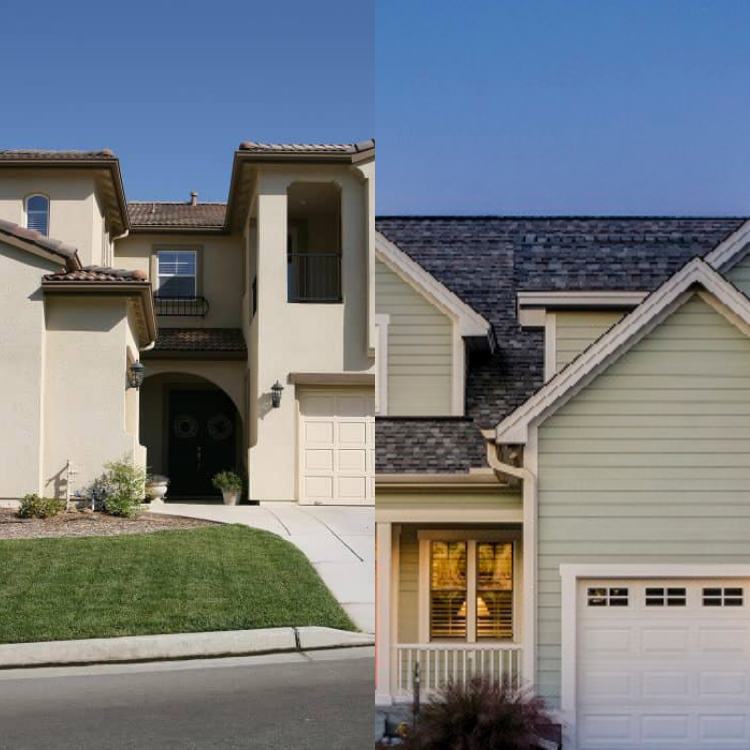
Brick, stone, and stucco are also compliant and noncombustible, though they tend to be more expensive and labor intensive to install. If stucco is more your style, we also offer stucco installation that meets the same code requirements.
Hardie also comes in enough product lines to fit just about any style you’re going for, whether that’s classic lap siding, vertical panels, shingle siding, or the smooth modern look of Artisan or Architectural Panel lines. Every one of them carries the same fire performance, so the choice comes down to aesthetics, not compliance. Beyond the fire rating, Hardie siding is also dimensionally stable, resistant to pest damage, and backed by a 30 year non prorated limited warranty, with a 15 year finish warranty on ColorPlus factory finished products. That combination of code compliance and long-term durability is a big part of why it’s become such a common choice on new builds and renovations across the region. Take a look at our siding and trim services to see the options we install across the Front Range.
An Insurance Perk Worth Mentioning
Beyond meeting code, there’s a practical upside for homeowners. According to a 2024 survey of insurance professionals, roughly 7 out of 10 said they may offer a discount for fiber cement siding based on its durability and ability to withstand the elements. Insurance carriers in Colorado have gotten more particular about wildfire exposure in recent years, and some are starting to factor exterior materials into premiums and even into whether they’ll write a policy at all in higher risk zones. Worth a call to your insurance agent if you’re weighing options, since the discount can help offset some of the upfront cost of upgrading.
What This Means If You’re Planning a Project
If you’re in a WUI zone along the Front Range and you’re thinking about a siding replacement, a new build, or an addition, the smart move is to plan around the code now instead of retrofitting later. That means:
- Confirm whether your property falls within a designated WUI zone and what fire intensity classification applies.
- Budget for a WUI inspection if your siding project covers 50% or more of the home.
- Choose exterior materials, siding, decking, and roofing alike, that are already compliant rather than ones that need extra fire-rated assemblies bolted on.
- Ask your contractor about the permit and inspection timeline up front, since WUI projects can involve an extra review step compared to a standard siding job.
We work with homeowners and commercial property owners across the Front Range on exactly this kind of project, from full siding replacements to new construction, and we’re happy to help you sort out what your property needs before you commit to a material.
Frequently Asked Questions
Do I need to comply with the Colorado Wildfire Resiliency Code if I’m just replacing my siding?
It depends on how much of the siding you’re replacing. In Colorado Springs, replacing 50% or more of a home’s siding in a WUI zone triggers a WUI inspection, and the permit has to be signed off by the fire department. Smaller repairs or partial replacements may not trigger the same requirements, but it’s worth confirming with your building department before starting.
How do I find out if my property is in a WUI zone?
The state has published an official CWRC map that shows designated wildland-urban interface zones and their fire intensity classification. Your local building or planning department can also confirm this for a specific address.
Is vinyl siding banned in Colorado’s WUI zones?
Not banned outright, but it’s restricted. Vinyl siding is only compliant in Moderate or High Fire Intensity zones if it’s installed as part of a 1-hour fire-rated wall assembly, which adds cost and complexity compared to a naturally noncombustible material like fiber cement.
Does Hardie siding meet the Colorado Wildfire Resiliency Code?
Yes. Hardie fiber cement siding is verified noncombustible per ASTM E136 and carries a Class A fire rating under ASTM E84 with a flame spread index of 0. It meets CWRC Class 2 structural hardening requirements for exterior walls without needing an additional fire-rated assembly.
Can I still use wood decking on my property?
Not in a designated WUI zone under the Colorado Springs Fire Marshal’s requirements. Decking and stair treads have to be fiber cement, concrete, or another approved ignition-resistant material. Wood is still permitted for structural members like joists, posts, and railings in most cases.
Will using fire resistant siding lower my insurance premium?
It might. Roughly 7 out of 10 insurance professionals surveyed in 2024 said they may offer a discount for fiber cement siding due to its durability. Discounts vary by carrier and location, so it’s worth a conversation with your insurance agent.
When does my local jurisdiction have to enforce the new code?
Local jurisdictions with WUI areas are required to adopt the CWRC as a minimum standard by April 1, 2026, and full compliance is required by July 1, 2026, or within three months of local adoption, whichever comes sooner.
If you want to know where your property stands or you’re ready to talk through Hardie siding or stucco options that fit both the code and your home’s style, get a free estimate and we’ll walk through it with you.